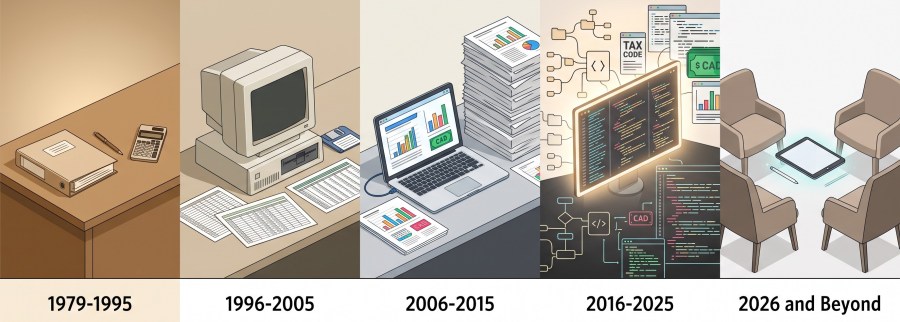
For the past twenty-five years, we have systematically confused complexity with value.
In the two years since ChatGPT and generative AI went mainstream, a frantic technological race has taken hold across the wealth management industry. Every company developing financial planning software for advisors is now rushing to embrace artificial intelligence (AI). We are seeing a flood of digital agents, branded with catchy names and trained to make suggestions that might help to improve projected outcomes decades into the future. Other tools dress up reports with AI-generated images that mirror a client’s personal hobbies in a desperate attempt to paint simplicity onto the complex.
But these flashy technological applications ignore a fundamental, uncomfortable truth about our profession. For the past twenty-five years, we have systematically confused complexity with value. In our pursuit of building ever-more sophisticated, mathematical engines, we have ultimately shut out average Canadians from accessible, meaningful financial guidance. We continuously champion the ideal of democratizing financial advice for all, yet our obsession with complex, data-heavy systems has inadvertently achieved the exact opposite. We have widened the advice gap, erecting an invisible paywall that leaves most everyday Canadians to navigate their financial lives alone.
The true promise of this new era is not in generating better Monte Carlo simulations or forty-page reports for the wealthy. If we are to survive and actually serve the public, we must realize that AI is not a tool to manage our self-serving complexity; it is the tool we must use to finally tear it down.
The Golden Era of Connection
In our pursuit of looking sophisticated, we traded our greatest advantage, the human connection, for the illusion of certainty.
I started in this industry in 1979, the same year my eldest son was born. At that time, financial advice was a binder with pages that you flipped through in front of the client to explain the advice or the financial product you were recommending. I started out going door-to-door, talking to people about why they needed life insurance. There were no computers, no internet, and no complex technology standing between us, just me creating a connection with the people I was talking to.
The process was entirely transparent. I used a paper form to ask questions, wrote down the answers, and followed instructions using a compound interest table on the back of the page. I could use a factor to calculate the future dollar value of a single investment or annual deposits, doing the math in front of the client using a simple calculator. It was live, interactive, and deeply personal. We worked through it together; the plan was theirs and not something that I retreated to my office to build and present to them later.
It didn’t take hours, days, or weeks for me to get back to them with an answer. It was one meeting, one interview, and then answers. Because they had participated in the planning, they understood it. At the end of each meeting, clients knew two vital things: they were okay, and they were happy with their decisions. It was a simple time that offered a real work-life balance. There was no email, cell phones, social media or text messages, and financial planning wasn’t a drawn-out process or a multi-week event. It was a singular, impactful moment in front of the client.
Yet, looking back over my 47 years in this business, I can clearly see where we lost our way. As an industry, we spent the next four decades building technology to mathematically predict an unpredictable future. In our pursuit of looking sophisticated, we traded our greatest advantage, the human connection, for the illusion of certainty, stepping blindly into a trap of our own making. We had achieved a balance where the calculator served the conversation, but as desktop computers and Excel spreadsheets entered the market, the temptation to show our math became irresistible. We confused the ability to calculate more data with the ability to provide better advice.
The Descent into Complexity
It was no longer simply about saving more or spending less; it was about optimizing, squeezing every drop of after-tax return from every dollar, and pretending we could predict the future.
In the decade between 1994 and 2005, technology really began to enter financial advice. It wasn’t advanced technology at first, just simple spreadsheets and heavy, slow desktop computers where you loaded software from floppy disks. Early programs simply took the paper forms of the previous era and turned them into digital calculators. You would enter the data, hit ‘F9’, and instantly bypass the old handheld calculators and printed compound interest tables.
But we did not stop there. Instead of simply telling a client what they needed to save for retirement, we started showing them year-by-year calculations. We displayed every granular detail: starting values, interest growth, taxable amounts, and end-of-year balances. These 40, 50, and sometimes 60-year ledgers quickly became table stakes, and mainstream advisors would not even consider software that didn’t show this level of detail. We added line and bar charts, anything to add colour and impress the client with our latest technology.
By the time we moved into the 2006 to 2015 era, software had left the desktop for the internet-connected laptop. We could now bring our technology directly into the client’s home or office, but the downside was that the time it took to create a financial plan more than doubled. We had done an amazing job of convincing the public that they needed more calculations and more “what if” scenarios. It was no longer simply about saving more or spending less; it was about optimizing, squeezing every drop of after-tax return from every dollar, and pretending we could predict the future.
This was the birth of the comprehensive financial planning engagement. Forty-page reports became the standard because analyzing every possible aspect of a client’s financial life was now the minimum expected from all software providers.
Sales concepts went mainstream, integrating heavily into financial planning software. Software could now illustrate complex corporate insurance structures, like the 10/8 strategy, where a corporation deposited operating capital into a universal life policy to earn a guaranteed 8% tax-sheltered return (provided they borrowed it back at a 10% tax-deductible rate). The Canada Revenue Agency (CRA) eventually closed this loophole, proving that basing a financial plan on predicting future tax law is a fool’s errand. Not to be outdone, the investment side leaned into Guaranteed Minimum Withdrawal Benefits (GMWBs), which promised a guaranteed income for life even if the underlying investment went to zero. We built complex illustrations around these products, firmly ignoring the reality that we cannot predict the future of investment returns any better than we can predict future income tax legislation.
The operational cost of this shift was massive. What used to be a single, one-hour meeting evolved into a multi-week, multi-meeting ordeal. We had the first meeting for exhaustive data gathering, a second for delivering recommendations, and a third just to handle the many “what if” scenarios. I honestly believe most clients never truly understood this level of detail, but we felt they needed to see it. We were no longer simply connecting with people; we were burying them in complexity.
By turning a single, one-hour conversation into a multi-week ordeal, we convinced ourselves that exhaustive detail was a feature rather than a flaw. As internet connectivity and portable laptops finally untethered us from the desktop, we didn’t use that mobility to deepen human relationships; instead, we doubled down on the data, setting the stage for an era that would be defined entirely by the math.
The Algorithmic Wall and the Advice Gap
Shut out by the complexity we built, a significant portion of the public now gets their advice from social media or turns to an AI application called ChatGPT.
From 2016 to 2025, Software as a Service (SaaS) exploded into financial planning. With automatic updates to tax rates and calculations, new features were added automatically at an accelerated rate, and access to the internet and social media made every type of financial planning mainstream. If you did not use these complex financial planning software platforms, you were considered a salesperson. Algorithms made even more possible, allowing us to seamlessly optimize a plan for income tax or map out the perfect withdrawal sequence in retirement. Programs would automatically calculate the answers to the four main questions clients had: How much can I spend? When can I retire? What rate of return do I need? And how much do I need to save?
Optimizing Canadian government benefits became a major planning obsession during this time. Rather than simply helping clients navigate their retirement transitions, financial planning software had to compare and calculate 120 different start dates for the Canada Pension Plan (CPP), alongside 60 different start dates for Old Age Security (OAS). Combining these created thousands of potential ‘what if’ scenarios, forcing the advisor to manage scenarios rather than human anxieties. But the algorithms and automation did not reduce the time it took to create a financial plan; they served to do the exact opposite.
Because of all this technology, the learning curve increased exponentially. Unless you were using the software eight hours a day, 7 days a week, you would never learn how to use everything it offered. When I started with a calculator, pen and paper 47 years ago, there was no learning curve. Today it can take months for a financial advisor to learn how to use a fraction of the capability some planning software offers. The entire industry now identified with complexity, broadcasting a clear message to the consumer: “You can’t do it yourself; this is too complicated.”
This technological arms race ultimately created a paywall around financial advice. To get help today, you need a minimum amount of investable assets or you need to write a big cheque, something that most of the Canadian population cannot easily do. We fail to walk the talk when we champion “financial advice for all”. Shut out by the complexity we built, a significant portion of the public now gets their advice from social media or turns to an AI application called ChatGPT.
This self-imposed paywall of complexity has reached its absolute breaking point. We had spent decades building software that automated every possible tax scenario and withdrawal sequence, yet we ignored the human element entirely. It was this exact failure, automating the math while abandoning the client’s emotional well-being, that has primed our industry for a fundamental reset.
Artificial Intelligence as the New Calculator
Personal finance is not just about numbers; it’s about how those numbers make us feel, and there is absolutely no training data for being human.
We started with a calculator, pen and paper, moved on to desktop computers and spreadsheets, advanced to laptops for mobility, and then embraced cloud computing. Today, we sit in a completely new stage, experimenting with Artificial Intelligence. AI is now available to everyone, and the foundational models are getting so good that providers are pre-training them for personal finance. Make no mistake, they are coming after financial advice and the advisors that deliver it.
Today, many financial advisors I talk to are concerned that AI will replace them, but it will not. AI is trained on enormous amounts of data, but our clients’ lives are built on personal experiences. Personal finance is not just about numbers; it’s about how those numbers make us feel, and there is absolutely no training data for being human. Human connection is, and always will be, our greatest advantage.
Financial advisors moving beyond 2026 need to embrace this return to the era of the calculator. AI embedded in the software programs we use allows us to start over, not with the suffocating complexity of columns, ledgers, and forty-page reports, but with a direct, one-on-one connection with the clients we serve.
This is what I believe is the true future of financial advice: the calculator is a deterministic mathematical algorithm, the pen is Artificial Intelligence, and the paper is a living client portal that clients can access anytime they have a question about their financial plan.
The true promise of artificial intelligence isn’t about running better numbers or generating faster calculations. It is about being able to take everything we know about a client, their hopes, their dreams, and what keeps them up at night, and seamlessly combining that human context with deterministic calculations. It is the ability to convert all that rich data into one clear, human conversation that clearly explains what they need to do, and most importantly, answers the question, “Are we okay?”
Imagine a couple sitting across the desk, visibly stressed about renewing their mortgage at a higher interest rate. In the era of comprehensive complexity, an advisor would have retreated to their office, spent hours adjusting assumptions, and returned days or weeks later with a revised forty-page plan to prove the clients’ retirement wasn’t derailed. Today, the deterministic calculator runs the math instantly in the background. The AI synthesizes those raw numbers with the clients’ deeply personal realities, their fear of outliving their savings and their desire to help their children, and distills it down to a simple, actionable conversation. We no longer stare at a dense spreadsheet to find comfort; we look each other in the eye, and tell them with clarity and confidence that their family is okay. By letting this new technology handle the heavy lifting quietly in the background, we can finally dismantle the barriers we spent the last twenty-five years building. We are now free to get back to what matters most, returning to the qualitative, values-based roots of our profession.
Restoring the Human Advantage
A financial plan must answer the only question that truly matters: Are we okay?
We need to change as an industry. We need to do better at communicating with our clients and stop pretending that the math is our primary value-add. It is not. For the past twenty years, comprehensive financial planning and sheer complexity have been the manifesto of our industry, but that era must end. A financial plan must ensure that at the end of the engagement, the client is happy with the result. And it must answer the only question that truly matters: Are we okay?
Delivering those two things does not require a forty-page financial plan, and it certainly does not require us to act as fortune-tellers. We cannot predict the future of income tax, we cannot predict the future of market returns, and we cannot predict the unpredictable twists and turns of our clients’ lives. We can calculate how much tax a client owes today on their estate. We can calculate their net worth today, and we can calculate today’s cash flow to see what is left over at the end of the month. But we cannot calculate any of that next year, five years from now, or thirty years from now. Nobody can, and frankly, clients know it. Anything else is just the industry trying to make itself look important.
Our true value-add is answering “Are we okay?” in the positive, and then being there for the moments that matter. The real work is helping a client navigate a career change when they are suddenly laid off or helping them renew their mortgage and adjust their budget because interest rates just went up. It is helping them save for a first home, pay off high-interest debt, protect their family with life insurance, an updated Will, a Power of Attorney, and a retirement plan that actually has a reasonable chance of success.
Financial planning needs to go back to a simpler time. We need to permanently dump the idea of complexity, projecting and forecasting a future we cannot possibly predict, yet pretending the plan is superior because it calculates exact income taxes for the next four decades. We must return to a time when a financial advisor would simply sit across the table, have an honest conversation, ask meaningful questions, and provide real answers.
How do we execute this shift and tear down the paywall we have built?
Financial advisors can embrace this new era by committing to a fundamental reset. It begins by returning to our roots and connecting one-on-one with the client. It is this direct, human conversation that will help you truly understand their needs, clearly explain your process, and deliver actual human connection rather than theoretical projections. To make room for this connection, we must finally ditch the complex spreadsheets. Walking away from massive ledgers and endless “what if” scenarios will drastically reduce friction, avoid the illusion of mathematical precision, and make the entire planning process infinitely more efficient.
Once that technological friction is removed, the path forward becomes clear: we must address the client’s most pressing concern first. Instead of overwhelming them with a comprehensive forty-page analysis of the rest of their life, give people what they want and need in that exact moment. Create a genuine relationship by solving their immediate anxiety, whether that is a sudden career shift or a stressful mortgage renewal. Once you have established that trust and simply answered their most pressing question, you can then begin to advise on everything else.
Dave Faulkner
Founder VibePlan.ca

